Showing posts with label arms. Show all posts

The Top 5 Best Triceps Exercises

Two common questions you will hear from male weightlifters are:
  1. How can I get bigger arms?
  2. How can I bench press more weight?
Normally I would scoff at such questions, except that the answer is a lesson that most young weightlifters need to learn.
Because your triceps comprise two-thirds of your arm, the answer to the first question is: train your triceps.
Because your triceps are often the weakest link in the chain of muscles that facilitates bench press, the answer to the second question is: train your triceps.
This brings me to the point of this whole post, which is how best to train your triceps.

Anatomy of the Triceps

The triceps brachii has three heads that connect the humerus and scapula to the forearm bone called the ulna.
These heads are known as the Lateral, Medial, and Long heads.
The lateral head is located on the outward facing side of the humerus.
This head is most responsible for the horseshoe shape of the triceps.
The medial head is located towards the midline of the body.
The long head runs along the bottom side of the humerus and is the largest of the three heads.
Again I will mention that your triceps make up about 70% of the total muscle mass of your upper arm.
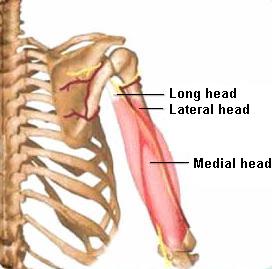
Triceps Anatomy
Triceps Anatomy

Functions of the Triceps

The primary function of the triceps is to extend the elbow, which results in straightening the arm.
The secondary function of the triceps is fulfilled only by the long head of the muscle, which is to adduct the arm (or to bring the arm down towards the body). The triceps shares this function with the latissimus dorsi (back muscles).

Top 5 Best Triceps Exercises

A number of criteria went in to selecting the best triceps exercises. I focused on compound exercises over isolation. We also want to be able to go as heavy as possible in order to build the size and strength we are seeking. Work a couple of these exercises into your weekly training, and you will see a huge improvement in your triceps within 2 months.
Until I get my video camera set up, you can enjoy the following videos from YouTube.
  1. Close grip bench pressClose grip bench is probably the best triceps exercise on the planet. This exercise allows you to go heavy and put maximum stress on the one muscle besides the pecs that can help increase your bench.You want to set up like a regular bench press, but position your hands no wider than shoulder width. On the descent, you want to keep your elbows in; do not let your elbows drift away from your body like you would with a regular bench press. At the bottom of the movement, you want the bar to come to the lower portion of your chest; at the top of the movement, the bar should be over your upper chest.
    Ideally, your forearms should be perpendicular to the floor at all times. Your hands and wrists should be directly over your elbows throughout the movement.
  2. Dips (weighted)A classic triceps builder. Keep your body as upright as possible to put the stress on your triceps rather than your chest.Use a belt with a chain to add weight to your body if you can do more than 5 reps at bodyweight. Be careful to always respect the flexibility and stability of your shoulders. Be sure not to lower your body so far that your shoulders become compromised, and always use strict form and a bounce-free concentric movement.
  3. Rack lockouts or board pressTrue powerlifting exercises, these two can be used interchangeably but only choose to use one of these exercises in any given workout. For the most part they train the same muscles.The goal here is to train the top portion of the bench press, where triceps rain supreme. I prefer rack lockouts because if I do use too much weight I can just rack the bar, and I don’t have to worry about carrying around a bunch of boards nailed together as if I didn’t already carry enough equipment around in my gym bag.

    Rack Lockouts


    Board Press

    However, most powerlifters that I have ever known prefer the board press to rack lockouts. I believe this is because the board press is identical to a regular bench press, except that the range of motion is much shorter (and there’s a big board on your chest). You can also vary the thickness of the boards from 1 inch to 10 inches or whatever you need for your workout.
  4. Lying French press (aka skullcrushers, nosebreakers)This is as close as I’ll get to recommending a triceps extension type exercise. The reason I like this exercise so much is that you really can work up to a decent weight, and it works your triceps from a different angle than any of the pressing movements.I suggest using an EZ curl bar and positioning your hands shoulder width apart. Lower the bar under control down to your nose, your hairline, or behind your head. If you feel any pain in your triceps, opt to lower the bar behind your head. In the following video we split the difference… this guy lower the bar to his hairline. I typically prefer behind the head.
  5. Close grip (diamond) push ups (with a clap)What? How did this get in here? No seriously, if you can bang out a set of 10 diamond push ups that’s great, but can you clap after each rep. This is an exercise that will really condition your triceps to contract with maximum force.You want to position your hands underneath your chest with index fingers and thumb tips touching. The space between should form a diamond. As soon as you can do 10 of these without the clap, add the clap. In order to clap properly you will need to push yourself up high enough to execute the clap and return your hands to their proper diamond position for the next rep. If this is too hard you can work up to it by placing plates or books beside your hands, and ‘jump’ up onto them. This is initially a shorter range of motion than a clap.
    In the following video this guy is just doing regular diamond push ups without a clap. We do these in thai kickboxing class.
If you use a 3-day full body training split, you can probably choose 3 of these exercises, using 1 each day. If you have an ‘arm day’ (which is a totally bogus topic for another day), you can probably choose 2 of these exercise for your triceps routine.

The Top 5 Best Biceps Exercises

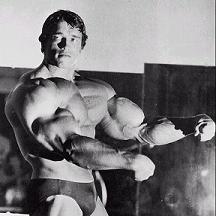
Arnold Biceps
Biceps. The ultimate show muscle. From age 10 on, every boy, teenager, and man want to have bulging biceps. This is, apparently, a true sign of manliness and strength.
Biceps are among the most famous muscles in the body. When somebody asks you to “make a muscle” or “flex”, they aren’t asking you to flex your hamstrings. They want to see your biceps!
This whole notion of flexing the biceps as a measure of anything, is completely ludicrous to me, but it is a reality. When someone asks me to flex, I ask them if they’d much rather discuss max effort PRs, perhaps dynamic powerlifting strategies, or better yet how to put together the most effective HIIT complexes. Most folks walk away thus. But I digress…

How to Get Big Ass Arms

Of course, to have big arms one must work the triceps twice as hard as the biceps. For this, you may refer to my post on the top 5 best triceps exercises.
The next thing you should know, is that compound back exercises build biceps mass best. Sure, you can perform isolated curls until the cows come home, but chances are if you are just curling, your biceps aren’t growing. For this, you may refer to my post on the top 5 best back exercises.
Now we must examine how the biceps work so that we can better target them for growth.

Anatomy of the Bicep

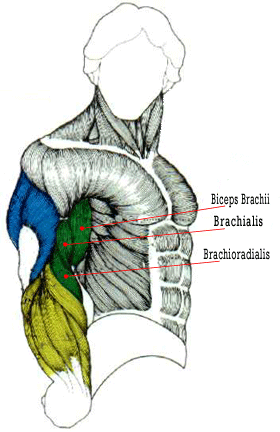
The biceps brachii is attached to a forearm bone called the radius and originates at the scapula in two places. In fact the bicep gets its name from this two headed structure; we refer to it as the long head and the short head of the biceps.
The biceps brachii runs down the front, or anterior, side of the humerus and makes up approximately 1/3 of the muscle mass of the upper arm. As I mentioned before, the 3 standards heads of the tricep make up the other 2/3 of your upper arm mass.
Two additional parts of the bicep are called brachialis and brachioradialis. These are a little muscles on the outside of the bicep that contribute to elbow flexion. Typically there is no need to train these specifically, unless you are a bodybuilder.
Biceps Anatomy
Biceps Anatomy

Functions of the Bicep

The primary function of the bicep muscle is to flex the elbow, which moves the forearm towards the shoulder. The explains the standard bicep “curl”.
The secondary function of the bicep is supination of the forearm, which means turning the hand from a palms-down position to a palms-up position. This is why a a rotational type of curl is always good to add to your bicep training arsenal.

The Top 5 Best Biceps Exercises

I thought about avoiding all compound exercises that exist in the top 5 best exercises for any other muscle group. But I can’t. The reality is that the top 5 best biceps exercises include a form of rowing and a form of chin-up/pull-down. Therefore I will present the top 3 best direct biceps exercises and the top 2 compound exercises that you should use if you want big biceps.
Never should your workout program contain an ‘arm day’ where you focus only on biceps. There’s no need to do more than two biceps exercises in any given workout, and those two exercises better be two totally different movements.
  1. Standing barbell curl
    If there was ever a ‘compound biceps exercise’, this would be it. This is the only direct bicep exercise that you can just pile weight on and use all the muscle of the biceps and forearms to get the weight up. Standing barbell curls are the only must-use exercise if you want tank arms.To set up: load a standard 45 lb barbell with some weights, and pick it up. Your hands should be supinated (palms up), about shoulder width apart. Arms should hang down beside/in front of your body, the bar in front of your hips. Tuck your elbows into your sides and DON’T move them throughout the exercise. To curl: keeping your elbows tucked in place at your sides, curl the bar up to your chin, but not so far that your forearms are perpendicular to the floor. Always keep tension on the biceps throughout the motion. Do not let the biceps relax at the bottom of the rep, but also don’t bounce the bar off your hips or quads in order to start the next rep. Keep tension on the biceps.
    Variations: wide grip, medium grip, narrow grip; standing ez curls with a 20-25 lb ez curl bar. Do reverse curl to work your forearms.
    I don’t know what kind of a bar this girl is using, but does it really matter?
  2. Alternating rotating dumbbell curl
    This is a simple exercise, that feels natural in its plane of motion. By alternating, you can focus maximal intensity on each arm separately.To set up: grab two dumbbells and hold them down at your sides, arms straight, palms facing your body. Again, keep your elbows tucked into your sides as soon as you start curling. To curl: start the movement with a hammer curl, then as the dumbbell clears your body, begin to rotate it so that at the end of the movement, your palms are facing your head. Once you lower the dumbbell back to the starting position, start curling with the next arm.

    Cheat Principles

    Here is an example, but this guy is definitely swaying and cheating. I couldn’t really find a good video for standing alternating bicep curls. Basically take this principle and instead of swaying, keep your elbows locked at your sides and just stand still while you curl.
    When you get to the last rep, you may feel free to apply a cheat principle by either swaying a bit or by raising the elbows away from the body, but this should only be on the last rep of the set.
  3. Hammer curl
    The hammer curl is great for developing the forearms, brachialis, and brachioradialis. I’m not sure about you, but I can hammer curl more than I can traditional curl, and lifting more with good form is always better than lifting less.To set up: grab two dumbbells and hold them down at your sides, arms straight, palms facing your body. Keep your elbows tucked into your sides as soon as you start curling.

    To hammer curl:
    you are basically curling the dumbbell up as high as it can go without moving the elbows. Ideally, the flat side of the dumbbell, at the top of the rep, should come close to touching the shoulder of the lifting arm. We call this a hammer curl because it looks like you are swinging a hammer. This means the palms face towards your body throughout the whole exercise. This guy here is doing his hammer curls close to his body. This is one way you can alter the plane of motion in order to lift a bit more weight. Notice how he still keeps his elbows stationary though? That is the point you should away from this vid.
  4. Supinated bent over rows
    OK, now we get into the real biceps mass gainers. When you curl you can use maybe 50-70 lbs dumbbells, or 120-150 lbs on a straight bar, but when you are rowing, you can load the bar up to well over 200 lbs. I personally remember bent over straight bar rows with 265+ lbs back in college.To set up: you will be grabbing the bar with a supinated grip (palms up/away) with your hands about shoulder width apart. You will need to either unrack the bar from a rack or stand, or deadlift the weight into a standing position. It is important to bent over so that your upper body is close to parallel to the floor, but not so much that your lower back rounds over. By pushing your butt back, you will be able to maintain a stronger core while getting lower to the floor.
    To row: the row itself is simply bringing the bar up to touch your abdomen, and lowering it down so that your arms are just short of fully extended. As always, keep your elbows in, as opposed to flared out to the side.
  5. Close grip chin ups
    YES! Biceps mass will be well on its way once you master this exercise. By keeping your hands close together and focusing on your biceps to lift your body, you will be essentially doing bodyweight curls. How much do you weigh? 150? 180? 220? Can you straight bar curl that much? I didn’t think so.There is a big difference between pull ups and chin ups though. While pull ups are good for your arms and back, close grip chin ups bring that whole movement to a whole new bicep-mass-building-level. To set up: find a straight bar that you can comfortably reach from a standing position. Grip the bar with an underhand/supinated grip (your palms should be facing you). Keep the hands about 4-6 inches apart; they should be right outside your chin on either side.
    If you are strong enough to do weighted pull ups or chin ups, add some weight either by crossing your feet and placing a dumbbell between your ankles, or hanging a couple plates from a weighted belt. A weighted belt should have a chain on one end and a loop on the other end, to which you should hook the chain. Put the chain through the hole in the middle of the plates and clasp the chain to the loop. Good stuff.
    To chin up: an important aspect of chin ups, is getting your chin up over the bar. While this isn’t a dire necessity, if you don’t at least get your chin up to touch the bar, you can’t call the rep complete.
    The girl in the following video has better form than most of the male pull up videos I found on YouTube.

The Top 5 Bicep Training Mistakes & How To Correct Them

Biceps are like burgers. Everyone loves them. Ask a child to make a muscle and he or she will strike a biceps shot. Bi’s are not only synonymous with posing, but also with exercise–and after your first year in the gym, you’ve probably read, heard or absorbed so much about curling that you’re tempted to skip ahead. Don’t. This article is for you, because it’s likely you’re making at least some of the following errors. This month, we’ll examine the most frequent biceps training blunders and lay out a plan for correcting each so that your curling course earns you an A in gun gains. Class is in session.

Mistake #1 – Cheating too early

Explanation

Biceps curls are probably the easiest exercises to cheat. Whenever your arms are not resting on a bench (as during a preacher or machine curl), all it takes is a little swing to shift some tension from your arms to your front delts and make a hard rep easier. Cheating is a valuable tool for pushing sets beyond strict, full-rep failure, but if you do so before then, it’s unlikely you will ever thoroughly stress your bi’s. In an effort to hump up heavier weights than they could otherwise use, many bodybuilders start cheating on curls from rep number one and increase their swinging as the set wears on.

Solutions

  • Do strict reps until you reach failure. If necessary, stand with your back against a wall during barbell or EZ-bar curls and/or press your elbows against your sides.
  • To remove your legs and hips from the movement, do dumbbell curls while seated.
  • To push sets beyond strict, full-rep failure, do two or three extra reps with a slight arm swing.

Mistake # 2 – Doing too much

Explanation

The popularity of biceps doesn’t make them any larger in relation to their peers. Compared with your lats and quadriceps, your bi’s are puny, so if you’re pumping out as many sets in your biceps workout as your back workout, you’re likely piling on the “little guys.” More than any other muscles, biceps are frequent victims of overtraining, which halts or even reverses their gains.

Solutions

  • Beginners should do only six sets for biceps. After four months of training, you can gradually add sets.
  • Advanced bodybuilders should typically do nine to 12 sets for biceps.
  • At maximum, push only the final set of an exercise beyond failure via techniques like cheating, forced reps, negatives and drop sets.

Mistake #3 – Missing the target

Explanation

More pabulum has been published about arm training than any other bodypart. For example, not long ago it was preached as gospel that to accentuate your lower biceps, “thou shalt do preacher curls” and to accentuate your biceps peaks, “thou shalt do concentration curls.” Neither “tenet” is true, so it’s no wonder that so many bodybuilders fire off curls but miss their intended targets. In fact, you can’t put any greater emphasis on your lower biceps than the rest of the muscle, and merely focusing on peak contractions won’t raise your peaks.

Solutions

  • Focus on the two heads of your biceps, which rest side by side.
  • Perform biceps curls with a grip that keeps the pinkies even with or higher than the other fingers to better recruit the biceps brachii short head (inner side). You also use the short head more when you take a wide grip on the bar.
  • Perform curls with the thumbs higher than the pinkies–as when taking an angled grip on an EZ-bar or when using a parallel grip for hammer curls–to better target the biceps brachii long head (outer side). You also engage the long head more when you take a narrow grip on a bar. Growing the long head can boost the slope of your biceps, thus accentuating the peak in poses such as the front double biceps.
  • Don’t expect to go from flat to barbed if it’s not preordained in your DNA, because the shape of your biceps is largely genetic. You should focus instead on maximizing bi size.

Mistake # 4 – Not incorporating sufficient variety

Explanation

Although the biceps are simple, two-headed muscles targeted almost exclusively via curls, you still need to perform various types of curls to properly tax the manifold fibers. Too many bodybuilders get in a lazy pattern of doing, for example, all standing, bilateral, free-weight curls.

Solutions

  • Do one EZ-bar or barbell curl exercise, one dumbbell curl exercise, and one machine or cable curl exercise each workout.
  • Do one of the exercises standing, one seated and one with the working arm(s) restricted against your body or a bench.
  • Do at least one unilateral exercise each biceps workout.
  • On occasion, do a unique exercise–such as drag curls, underhand chin-ups and rope hammer curls–to hit your bi’s from different angles.

Mistake # 5 – Skimping on contractions

Explanation

The contraction is the crucial component of a curl, so it’s unfortunate that so many bodybuilders never truly flex their bi’s against resistance. Generally, this is because they use too much weight and perform their reps quickly and with excessive momentum.

Solutions

  • Use a weight you can manage for eight to 12 strict, full reps.
  • Curl slowly. Take approximately two seconds to raise the weight, hold the contraction for one second, then take approximately two seconds to lower the weight.
  • During dumbbell curls, supinate your wrists so that your palms are facing your sides at the bottom of the movement and facing up at the contraction.
  • Make every curl a “concentration curl” by flexing your biceps at each contraction.

Lessons Learned

  • Perform strict, full reps. Cheat only to extend a set.
  • Use low to moderate volume.
  • Target your outer head to accentuate your bi peaks.
  • Do dissimilar types of curls in the same workout.
  • Control the weight and emphasize contractions.

Lying Triceps Extention

How to start

  • Lie  on a flat bench.
  • Hold the bar with your hands slightly less than shoulder-width apart and keep the palms facing forward.
  • The bar should be positioned directly over your head with your arms fully straight.

Movement of the exercise

  • Keep your upper arms still and then bend your elbows until it just touches your forehead.
  • Hold for 2 secs; then return back to the starting position.

Tips on Lying Triceps Extension

  • Keep your back firm on the bench.
  • For maximum output, straighten your arms fully at the end of the movement.
  • Do not allow your elbows to move out to the sides

Triceps Kickback

How to start

  • Hold the dumbbell in your one hand.
  • Bend forwards until your back is parallel to the floor.
  • Place your other hand and knee on a bench to maintain stability of the body.

The Movement of the exercise

  • Start by keeping your elbow stationary and thenextend your arm backwards until your arm is straight and parallel to the floor
  • Hold for 2 sec and then slowly return to the starting position.

Tips  and tricks on Triceps Kickback

  • Do not swing the dumbbell back.
  • Use   light weight dumbbell as the exercise is harder to perform in a proper way.
  • Keep your upper arm fixed,  move your  forearm only.
  • Keep your  back flat and still

Bench Dip

How to start

  • Place two benches about the length of your legs apart.
  • Place your hands shoulder-width apart on one of the bench.
  • Place your feet on the other bench and keep your legs straight.

Movement of the exercise

  • Bend your elbows until they make an angle of 90 with your arms.
  • Hold for 2 secs ,then slowly return back back to the starting position.

Tips on Bench Dip

  • Keep your back as straight as possible.
  • Keep the movement slow.
  • Do not lock  your elbows at the top position of the movement

Triceps Push-down

How to start

  • Place your hands on the bar on the triceps pull down machine.
  • Hold the bar with firm grip ,palms facing forward.

Movement of the exercise

  • Keeping your upper arms close to your body, press the bar down, moving only your forearms, until your arms are fully straight.
  • Hold for 2 secs; then slowly return to the starting position.

Tips on Triceps Push-down

  • Do not bent to much forwards.
  • Keep your wrists locked and your palms facing you.
  • Keep your elbows fixed  throughout the movement

Concentration Curl

Concentration Curl 
exercise

How to start

  • Sit on a bench and hold a dumbbell in your one hand..
  • Place the dumbbell on one of your thigh keeping your legs apart.

Movement of the exercise

  • Slowly move the dumbbell up  towards your shoulder.
  • Squeeze your biceps hard at the top of the movement, hold for 2 secs and then slowly return to the starting position.

Tips on Concentration Curl

  • Do not lean backwards while the movement.
  • Keep your upper arm fixed.
  • Keep your shoulder  relaxed.

Dumbbell Curl

Dumbbell Curl 
exercise 
How to start
  • Sit on the a bench and hold dumbbells in both hands
  • Your arms should be fully straight.

Movement of the exercise

  • Move one dumbbell up at a time  towards your shoulders, rotating your forearm and keeping your upper arm fixed.
  • Hold for 2 secs; then slowly lower the dumbbell back to the starting position.
  • Repeat with the other arm.

Tips on Dumbbell Curl

  • Do not lean backwards while the movement.
  • Curl the dumbbells up slowly upwards.
  • Keep your upper arms fixed while the movement.

Preacher Curl

Preacher Curl 
exercise 
How to start
  • Sit on the preacher curl machine, adjust the positioning  of your arms such that your armpits are touching on the top of the pads.
  • Hold a barbell with your hands shoulder­ width apart.
  • Your arms should be fully straight.

Movement of the exercise

  • Move your elbows in a smooth arc towards your shoulders.
  • Hold for 2 secs; then slowly return back to the starting position.

Tips on Preacher Curl

  • Lower the bar until your arms are fully straight , shortening the downwards movement will reduce the effect of the exercise.
  • Keep your shoulders relaxed do not lean forwards as you curl the bar .
  • Keep your wrists locked.

Barbell Curl

Barbell Curl 
exercise 
How to start
  • Stand  and hold a barbell with your hands shoulder­ width apart,
  • Keep the bar against your thighs and your arms should be fully straight.

Movement of the exercise

  • Move your elbows a in a smooth arc towards your shoulders, keep your upper arms fixed by the sides of your body.
  • Hold for 2 secs; then slowly return back to the starting position.

Tips on Barbell Curl

  • Keep your wrists locked.
  • Slowly lower the bar until your’ arms are fully straight, shortening the downwards movement will reduce the effectiveness of the exercise.
  • Do not move your upper arms during the movement
  • Do not lean your back as it can strain your back and reduce the effect of exercise on the biceps.

Arms

 Arms(biceps,triceps,forearms)Arms are visible proof of the work you put in at the gym.
Building arm muscles and strength will help you in many sports for example playing forehand strokes in tennis and squash,  hockey, playing a long shot in golf, climbing, grabbing an opponent in rugby , martial arts,  movements in gymnastics.
Triceps and forearms muscles are also involved in numerous hard activities. Common mistake while arms workout is to train only the biceps, thinking this will produce stronger and bigger arms and will look good. However, the triceps muscles make up the largest part of the arm muscles so it is important workout them for equal time and effort.

The Top 5 Best Forearm Exercises

http://www.musclesproduction.com/wp-content/uploads/2011/01/arnold-forearms1.gifEvery serious lifter would love to have massive forearms. It just adds to an already good physique, and would seemingly increase all of your other pressing lifts as well. The problem that most people have is that they aren’t sure how to attack their forearms. Either that, or they are not as consistent with their forearm training.
Forearms should be trained just as often as any other muscle. It shouldn’t just be something you work every couple of months whenever you are bored. Take your forearm training seriously, and you will be on the right path to adding some size on them.

How to Get Big Forearms

Many people think they have to do only direct forearm exercises such as wrist curls, and those will work to an extent, but with forearm training, you have to think outside the box and dumb things down. What is the one major exercise that requires you to have some strong ass forearms? Did I hear someone say deadlifts? That is correct.

Deadlifts, just like they work every other muscle in your body, they also work your forearms. Many people don’t get this much work because they decide to use straps whenever they go heavy. If you can deadlift a ton of weight without straps, then you are sure to have a great grip and huge forearms.
Aside from deadlifts, which you will read about more in a minute, I want to introduce you to 5 other exercises and a variety of techniques that you can use to build great size and strength in your forearms.

Anatomy of the Forearms

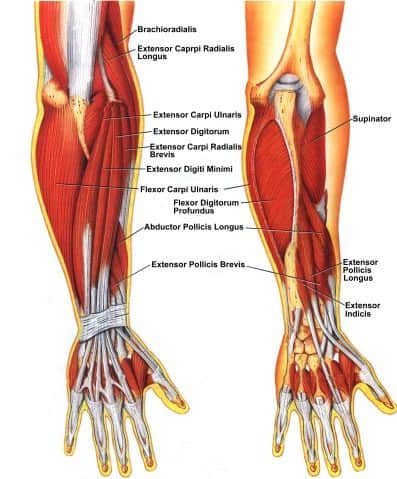
The forearm comprises around 20 different muscles, but it contains two main ones: the flexors and the extensors. The flexors are on the side of the palm of the hand and the extensors are on the opposite side.
Forearm Anatomy
Anatomy of the Forearms

Function of the Forearms

The flexors and the extensors both regulate the movement of the wrist, fingers, thumb, and they can also control which way the hand faces.
The muscles of the forarms are pretty much responsible for controling the whole hand.

The Top 5 Best Forearm Exercises

Although it is not specifically a forearm exercise, I must list this next exercise as very best forearm exercise. I’m listing first, but I won’t count it as one of the top 5. Consider this forearm exercise #0 – an in “ground-zero” – as in the foundation of your training routine – as in you should use this exercise once every week.
  1. Deadlifts

    As mentioned above, the deadlift is an amazing exercise. Forearms are just another muscle that are hit hard by heavy deads. If you decide to use straps, then you will not get the maximum benefit, but if you can use just chalk then you will be well on your way to having strong and massive forearms.
    The lift: to start a deadlift, use your whole body to begin to lift the bar off the floor. Arms should be straight, hands shoulder width apart, knees should be bent. The object is to lift the weight with your legs, glutes, and hips, rather than with your lower back. In fact your lower back should not bend that much, should in fact be pretty straight, and should definitely NOT be rounded. You accomplish this by keeping your head up and by driving with your hips.
    As you push with your legs, remember to drive your feet down through the floor. It is of utmost importance to keep the bar close to your body during the lift.
    At the top you should stand up straight, but do not over extend your lower back as if you were doing some kind of hyper-extension. The driving force at the top should be more of a hip thrust than a lower back spasm. Lower the bar under control, keeping it close to your body.
    Deadlift grip: some people use a conventional grip with pronated hands – your palms face towards your body when you grab the bar. Most lifters find they are much stronger with an alternating grip – on hand pronated, one hand supinated. It is awkward the first couple times, but most athletes tend to prefer the alternating grip.
    Alternate your alternating grip! With each set you should switch the position of each hand. Some people tend to save their strongest grip for their heaviest set. This is perfectly OK.
    Layne Norton is using a bit of a different bar in this video, but it is the same concept.
  2. Farmer Walks

    Ok, this is another exercise where you may be wondering how this would do a great deal of more benefit than some type of wrist curls. It’s simple people. You will be holding a ton of weight for a prolonged period of time. Will your forearms be getting more work curling a 10 lb dumbbell or holding 400+ lbs? Exactly.
    The lift: Start by equally loading two shorter barbells, or some other odd object implement, with however much weight you wish. Once you do that, then you will pick up each bar, one with your right arm and the other with your left arm. Next you do the Walk – you will walk a certain distance or for however long you wish.
    You can try to keep adding weight while going the same distance each time. By doing this, your forearms and grip will continue getting stronger.
    You can try to walk further distances with the same weight, which will improve your stamina.
    You can try to walk the same distance with the same weight for time, which will improve your endurance.
  3. Plate Pinching

    A great exercise for finger and grip strength.
    The lift: You will need 4 plates to start with – 2 for each hand. Start with 5 lbs plates if you are small, weak, or female, otherwise start with 10s. Pinch two plates together with each hand. Your thumb should be on the bottom and your other fingers on top. If possible it is best to pinch with the flat sides out so you won’t get distracted by ribbing, knurling, writing, or embossing. Don’t you dare use the hole in the middle of the plate either. Cheater!
    You can use a stopwatch to see how long you can pinch without your grip giving out. To gauge progress, your goal is to pinch more weight for longer periods of time. You can also get an idea of which hand is strongest and use an extra set here or there to try to even out the imbalance.
    You could also attempt a 3 plate pinch, or if you feel really strong, try pinching some 25s or even 45s. Hey, the strongmen do it!
  4. Barbell Wrist Curls

    The lift: You will need a barbell to start off with. You may not want to start off with as much weight to begin. Once you get the bar, you will need to find a bench on which to rest your forearms. Position your arms so that you are resting your forearms on the bench with your wrists and hands hanging over the side.
    To perform regular wrist curls, your forearms should rest on the bench palms-up. You will slowly lower the bar by extending your wrists backward, stretching your flexors. Once you reach a full stretch, you should flex your flexors and curl your wrists so that the bar moves up and towards your face. For an extra finger workout, some people like to uncurl their fingers slightly at the bottom of the movement, letting the bar slide down to the tips, then curl the fingers back up tight before starting the wrist curl. I personally perfer the added finger curl.
    To perform reverse wrist curls, your forearms should rest on the bench palms-down. You will slowly lower the bar by curling your wrists forward and stretching your extensors. Once you reach a full stretch, you should flex your extensors, curling wrists up and back towards your face. Try not to extend your wrists so far back the the weight goes over or in back of your wrists, as this would remove the tension from the top of the lift. I’m not that flexible anyway, so I don’t have to worry about it. =)
  5. Hammer Curls

    Ever wonder how the old tyme blacksmiths had arms the size of watermelons? What do they do day after day after day? They swing 50 lbs sledgehammers with one hand for about 20 hours a day. You only have to do it a couple times a week but in short time you’ll have forearms and biceps like an iron worker.
    The lift: Grab yourself a set of heavy dumbbels. Hold them at your sides with palms facing each leg. Now curl the weight up to your either your shoulder or your chin, but keep your elbow tucked in at the side and pointed straight down. At no time should your elbow move underneath your wrist, as that would take the tension off your arms. Lower the bar back to your side to complete one rep. You can choose to perform this exercise with one arm, alternating arms, or both arms simultaneously.
  6. Reverse Grip Barbell Curls

    Yeah, this is mainly a biceps exercise, but it will work your forearm extensors out great. What better way to build both your biceps and forearms up at the same time? Except of course for hammer curls.
    The lift: You will need a barbell or EZ Curl bar to start with. After that, you will grip the bar the opposite way that you normally would during a regular curl, with palms down. Your forearms should be facing outward rather than inward. After that, you will just curl the bar up like you normally would with barbell curls. It’s the same movement, but you are performing it so your forearms are being worked. Simple enough.

Integrating Forearm Training Into Your Workout

Pick one exercise that isolates the forearms and pick another exercises that also targets the biceps. Use those exercises in one workout, then choose a different pair of exercises for your next workout. Try to repeat each exercise at least once a week. Just remember the forearms can still be overtrained if you incorporate too much direct forearm work into a routine with a ton of pulling and rowing.

Additional Forearm Training Strategies

Aside from incorporating the top 5 best forearm exercises into workout routine, you can improve your forearm training simply by using these additional techniques on other exercises.
  • Resist Using Wrist StrapsWrist-straps will take the stress off the forearms and short-change the trainer in this area. In order to fully stimulate the forearms, they require maximal squeezing.Straps compensate for a weak grip and it follows that they will negate any form of forearm stimulation, as they prevent optimal squeezing. Those with the strongest grips tend to have the biggest forearms.
  • Use A Thick Bar This will increase the difficulty associated with gripping the bar and will resultantly contribute to significant increases in forearm size. If you don’t have a thick bar, wrap a towel or a piece of rubber around the bar to make it thicker.
  • Use A Wrist CurlerEssentially a wrist-curler is a heavy plate (which can vary in weight) attached to a small bar via a thin rope. To execute this movement, hold arms straight out in front whilst gripping the bar.Slowly roll bar with one hand at a time until weight has been raised to shoulder height. Then unwind it and repeat, reversing the way in which the bar is rolled (change from working the flexors to the extensors).
  • BoxingRepeatedly punching a boxing bag requires a tremendous amount of forearm strength and periodically structuring boxing sessions into ones routine may provide an edge when it comes to developing these muscles to their fullest.Personally I have found that uppercutting the heavy bag with 50-punches, each arm, works wonders as far as developing the flexors goes.
  • Use a RopeWhen doing any kind of pulling exercise such as rows or pull ups, use a rope instead of a bar. You will have to squeeze hard towards the end of each set just to hold on to the weight. This might impact the other muscle group you are training (predominantly back when rowing or pulling), but will hit your forearms and grip hard.
  • Grab SandSand grabbing is a great grip strength exercise. Simply fill a bucket full of sand, reach in, grab a handful, let it go, grab another handful, flex your fingers, grab another handful, pull it out, drop it, reach in again, etc… Basically work your hands and fingers all around in the sand until your hands are completely fatigued.
  • Practice with GrippersI almost didn’t want to mention grippers because 99.9% of grippers suck. You will need to get the Captains of Crush grippers from Ironmind. Start with level 1 unless you are positive that you already have a world class grip. Work your way up to level 4 and you’ll be famous.

Share

Twitter Delicious Facebook Digg Stumbleupon Favorites